
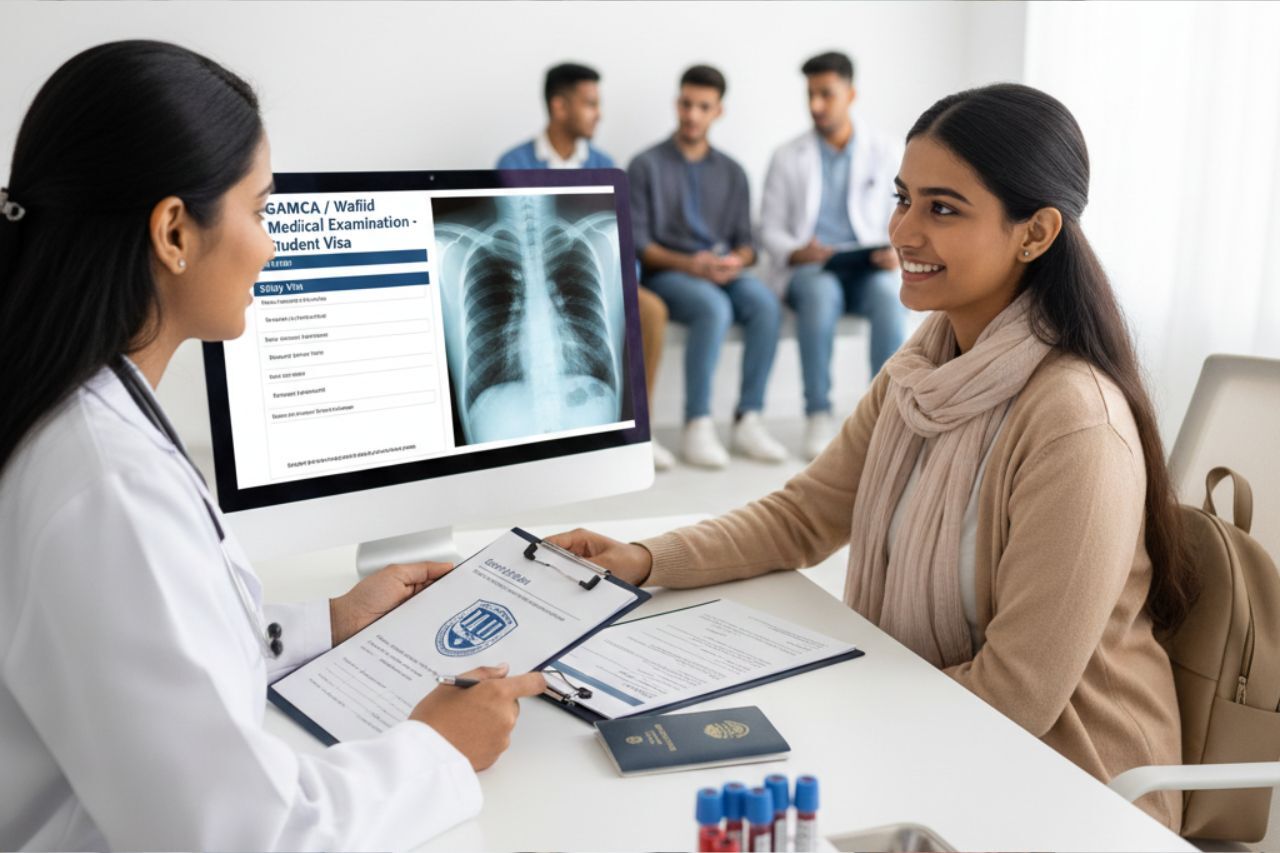
Many times, students who want to study in GCC nations, like Saudi Arabia, the United Arab Emirates, Qatar, Kuwait, Bahrain, and Oman, ask if obtaining a student visa requires passing the GAMCA medical exam. The GAMCA medical test is frequently necessary for employment visas; however, the requirements for students vary depending on the policies of each nation and the school granting admission.
This page describes what health checks are usually necessary for GCC study visas, when students need GAMCA medical testing, and their options.
Is GAMCA Medical Required for Students?
GAMCA medical is not required for student visas in the
majority of GCC nations. The main purpose of the GAMCA
system is to screen foreign workers for infectious diseases
and make sure they meet health fitness requirements prior to
employment.
However, while GAMCA is generally not required, some GCC
countries do require a medical examination, but it is
usually completed through:
Government-approved hospitals in the student’s home
country
University-authorised medical forms
Embassy-recommended clinics
This means students often undergo medical testing, but not
necessarily through GAMCA.
Country-Wise Requirement Breakdown
1. Saudi Arabia
Saudi Arabia typically does not require GAMCA for student
visas.
Instead, students must submit a medical report from an
approved hospital, covering:
HIV
Hepatitis B and C
Chest X-ray
Blood tests
General physical examination
The medical certificate must be attested as per embassy
requirements.
2. United Arab Emirates (UAE)
For the UAE, GAMCA is not used for student visas. Students
usually undergo:
A basic medical fitness test after arriving in the UAE
A blood test and chest X-ray (mainly screening for TB and
communicable diseases)
The UAE generally completes medical fitness procedures
inside the country, not in the home country, through GAMCA.
3. Qatar
Qatar does not require a GAMCA medical for students.
Most students undergo medical screening upon arrival, which
includes:
Blood test
Chest X-ray
Biometric enrollment
This test is required for issuing the Qatar ID (QID).
4. Kuwait
Kuwait generally does not use GAMCA for student visas, but
medical testing is required.
Some universities ask students to complete a specific
medical form certified by:
A government hospital
A licensed physician
The national health authority
5. Bahrain
Bahrain does not require GAMCA for student visas, but it
requires:
A health certificate
Basic communicable disease screening after arrival
6. Oman
Oman, like other GCC states, does not require GAMCA for
students.
Medical testing is typically conducted after the student
lands in Oman as part of residence procedures.
When Might a Student Be Asked to Take GAMCA Medical?
Although uncommon, a student may be asked to undergo GAMCA
medical if:
They are switching to an employment visa after completing
their studies.
The sponsoring authority insists on a GAMCA-based report.
They come from a country where GAMCA testing is standard for
most GCC visa categories.
This is not the norm, but it can occur in specific cases.
What Medical Tests Do Students Usually Need for GCC Study
Visas?
Even though GAMCA may not be required, students should
expect some or all of the following tests:
Blood tests for communicable diseases
Chest X-ray
General physical examination
Vaccination verification (MMR, Hepatitis B, etc.)
TB screening
COVID-19 vaccination certificate
Some universities also require proof of:
Fitness for study
No chronic illness that may affect performance
No disability that affects accommodation requirements (based
on country policies)
Is GAMCA Recommended for Students Even If Not Required?
Generally, no.
GAMCA tests are:
Strict
Non-refundable
Designed for workers, not students
Limited to specific GAMCA-approved centres
Unless explicitly asked by a GCC authority, students should
not undergo GAMCA medical unnecessarily.
Conclusion
The GAMCA medical exam is not necessary for student visas in
the majority of GCC nations. Rather, as part of the
residency process, students typically undergo a routine
medical checkup either after arrival in the GCC countries or
through general practitioners in their home country.
Compared to the GAMCA method used for job visas, health
screening is usually easier and less stringent, even if it
is still necessary.